







RESOURCES, REFERENCES
Notes on the development of the lamina terminalis in the human embryo v2 draft by B. Freeman 2026, for discussion (pdf)
SOURCES for images, etc. used in Dr. Freeman's presentations (updated 2023)
Mechanical effects on the genome known since 1948 by B. Freeman (letter) Nature 2021, 591, p.369
Memoirs of a Dutch medical student forced to work in Göttingen University anatomy department during the nazi period (translated, pdf, 2.6MB)
The developmental history of a sensory ganglion cell draft by B. Freeman, for discussion (pdf)
Let's stop saying that a muscle 'contracts' unfinished, unpublished article by B. Freeman, for discussion (pdf)
Presentation: Anatomy Lessons from History (2015, Part I) by B. Freeman (pdf, 1.1MB)
Presentation: Anatomy Lessons from History (2015, Part II) by B. Freeman (pdf, 1.1MB)
Presentation: The organism as a fluid continuum - abstract of lecture by B. Freeman at 11th International and Interdisciplinary Symposium of Osteopathy, OSD, Berlin, December 2014 (pdf)
Presentation: Asymmetry and mass transfer in the development of organs - abstract from workshop by B. Freeman at 11th International and Interdisciplinary Symposium of Osteopathy, OSD, Berlin, December 2014 (pdf)
Presentation: Fluid movements in Blechschmidt’s metabolic fields - abstract from workshop by B. Freeman at 11th International and Interdisciplinary Symposium of Osteopathy, OSD, Berlin, December 2014 (pdf)
Presentation: Facing Facts: craniofacial development - handout from lecture by B. Freeman at pre-conference workshop, 11th International and Interdisciplinary Symposium of Osteopathy, OSD, Berlin, December 2014 (pdf, 17.8MB)
Bibliography of articles, films, books by Erich Blechschmidt (1904–1992), his students and followers
Bibliography of articles by Eben J Carey (1889–1947) on histogenesis and muscle
New Concepts of Chemical and Biological Structure... by EB Cohen (1984)
Energy sources of blood circulation and the mechanical action of the heart by Leon Manteuffel-Szoege (1960)
Inner space: the strange extra-arachnoid world beneath the true dura by Charles W Needham (2006)
The Potency of Embryology Sutherland Cranial College Magazine, Issue 32 (2010): articles on embryology with interview of Brian Freeman by John Lewis (3.3 MB)
Substance of a LECTURE, Delivered at Newcastle, 28th of December, 1773, on the NATURAL POWERS employed in the CIRCULATION of the BLOOD, independent of the ACTION of the HEART... by Andrew Wilson (1776)
The heart arises at the transverse confluence of two tubes, not from their lengthwise fusion by Brian Freeman (2023)
Handout on autonomic and enteric neurones by B Freeman (2012)
Simple Calendar for Embryos; Carnegie Stages; Glossary of terms used in B Freeman's presentations on human embryology
The difference between Embryo and Conceptus - abstract of talk at Australian Birth Defects Society Annual Meeting, Melbourne, April 2005
Facing Facts: Development & Anatomy - abstract of lecture to Australian & New Zealand Association of Oral & Maxillofacial Surgeons, National Conference, Melbourne, October 2005
The active migration of germ cells in the embryos of mice and men is a myth by B. Freeman (review), Reproduction 2003, 125, pp.635–643
The myth of the "Biogenetic Law" by B. Freeman (letter) The American Biology Teacher 2001, 63, p.84
Human germ cells do not have to migrate in embryonic development by B. Freeman (abstract) Teratology 2001, 64, p.324
Human “branchial” whatevers: perpetuating Haeckel’s forgeries by B. Freeman (abstract), Teratology 2001, 64, p.324
Prenatal development of the face and airway - abstract of lecture at 6th World Congress on Sleep Apnea, Sydney, March 2000
The How and Why of the Eye by B. Freeman Direction 1999, 2, pp.10-16 (pdf, 16 MB)
Zur Diskussion (Haeckel's Law) by B. Freeman (letter) Naturwissenschaften 1987, 74, p.348
VISCERA (presentation)
2023 Freeman Viscera: ventral midline and brain–gut axis (pdf, 11MB)
SECONDARY NEURULATION
1935 Holmdahl Primitivstreifen Rumpfschwanzknospe Körperentwicklung (pdf, 3MB)
1939 Holmdahl Morphogenese des Vertebratorganismus (pdf, 6MB)
1987 Müller and ORahilly re secondary neurulation (pdf, 7MB)
1988 Müller and ORahilly human brain development from CS13 (pdf, 8MB)
1991 Kostovic secondary body formation rat embryo (pdf, 2MB)
1992 Griffith vertebrate tail bud (pdf, 6MB)
1993 Nielvestein re secondary neurulation (pdf, 2MB)
2001 Sapunar regression of human 'tail' (pdf, 2MB)
2004 Saitsu posterior neural tube human embryo (pdf, 2MB)
2007 Saitsu human embryo 'tail' bud and myeloschisis (pdf, 2MB)
2008 Saitsu review posterior neural tube development (pdf)
EQUINE DEVELOPMENT
1917 Ewart VII studies development horse third week (pdf, 41MB)
1917 Robinson VIII reconstruction horse embryo 21 days (pdf, 8MB)
2001 Acker equine embryo 17-40 days (pdf)
2014 Rodrigues equine embryonic cardiorespiratory development (pdf)
BOOK
Blechschmidt's Ontogenetic Basis of Human Anatomy
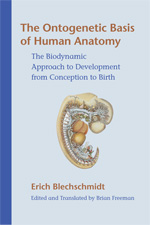
The Ontogenetic Basis of Human Anatomy is Brian Freeman's translation and annotation of Anatomie und Ontogenese des Menschen by Erich Blechschmidt. The translation is published by North Atlantic Press (2004).
ARCHIVE: STEP INTO LEONARDO'S SHOES... ANATOMY DRAWING WORKSHOPS
University of New South Wales, 2000–2007
In 2000, Susan Dorothea White and Brian Freeman co-established public anatomy drawing workshops at The University of New South Wales. The workshops were held in the Anatomy Laboratory (Dissecting Room) of the university's Department of Anatomy and gave the public a rare opportunity to draw actual human specimens that were normally seen only by medical and science students. Intensive 5-day workshops were held twice a year during the summer and winter university recess, when the absence of students meant that the laboratory was quiet and suitable as a 'drawing room'. Other workshops were conducted on weekends, which aslo provided a unique, contemplative atmosphere. The workshops attracted interstate and international participants from all walks of life, from surgeons to train drivers, artists to crime writers, builders to physicists. Students and professionals in art, as well as tertiary art teachers, also attended.
Press articles on Anatomy Drawing Workshops (extracts)
Bringing the dead back to life – on paper
'...The mystique of the body is stripped away, parts named. The trapezius muscle is the "monk's hood", the latissimus dorsi is "the bottom scratcher", the levator scapulae "the muscle of indifference". At the art history lecture, White introduces the class to images of the body in art, the ways it has been represented in different cultures. There's Rodin's Thinker, a graceful Degas, a Fernand Léger abstract, dancer Sir Robert Helpmann - "a real artist of movement", White says - figurines from Angkor Wat, a delicate sculpture of a hand from Camille Claudel, works by Albrecht Dürer, Michelangelo, Hokusai, and finally, of course, da Vinci. For those wanting to hone their art skills, there's plenty of material to work with...'
Sharon Verghis, The Sydney Morning Herald (5 April 2001)
Drawn and quartered
'The University of New South Wales last week provided a rare chance for people from artists to plastic surgeons to take up the Leonardo da Vinci role by sketching body parts from the university's collection. The weokshop seeks to revive old skills and bring together science and art. Specimens used in the School of Medical Sciences annual Leonardo workshop are embalmed and professionally dissected parts from bodies donated to the university for study....Artist Susan Dorothea White gave artistic guidance during the week-long workshop. Ms White said that by discovering what is under the skin, participants improve their skills in rendering the human form...Sketching sessions were interspersed with illustrated talks on the influence of anatomy in art history, with slides of works by artists such as da Vinci, Rodin, Alice Neel, and Hokusai...'
Patricia Karvelas, The Australian (19 February 2003)

